

It is beyond question that the online food delivery industry in the Middle East and North Africa (MENA) region has expanded monumentally in recent years. During the COVID-19 pandemic in particular, online ordering through applications such as Taker, Careem NOW, Hunger Station, Talabat, and Jahez went from being a simple convenience to a vital survival strategy.
In a way, the food and beverage (F&B) businesses and quick-service restaurants (QSR) in the covid-stricken world received a lifeline to keep things afloat in dire economic conditions. Customers also reaped several benefits in the form of:
- Flexibility of ordering from any location
- Easy ordering process
- Queue avoidance
- Improved order precision
- Diverse culinary options
- Order customization
- Attractive deals and promotions
- Safe, contactless delivery
Unsurprisingly, the MENA food delivery market posted a sales revenue of US$3.14 billion in 2023 and given the growing penetration in the region, the figure will surely cross double digits in the coming years.
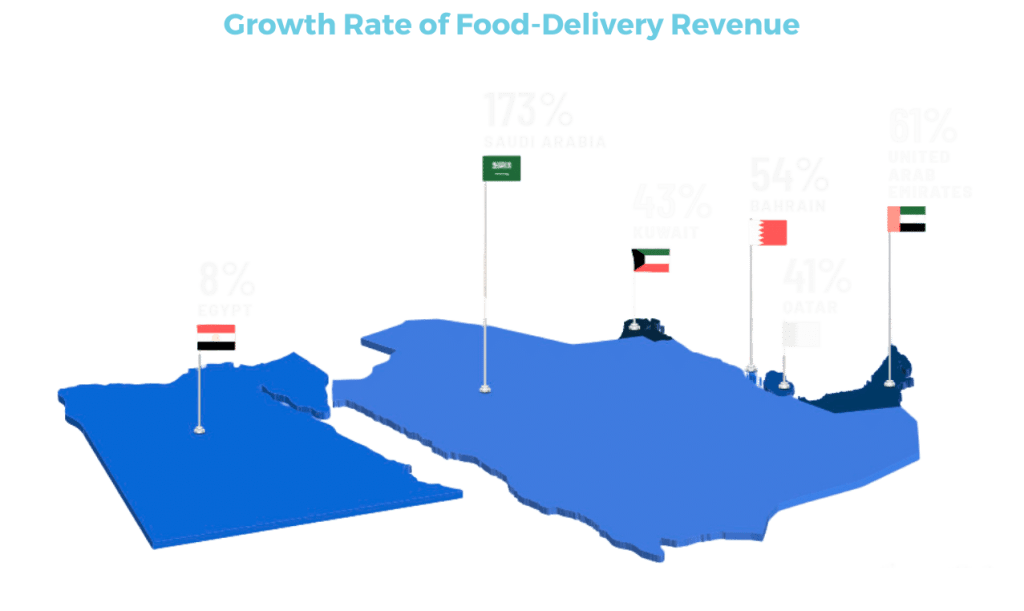
That being said, while the rising number of restaurants, fast-food chains, and cloud kitchens in MENA successfully cater to a diverse palate, the truth of the matter is that top-notch quality, speedy deliveries, and happy customers remain a formidable challenge in this demanding sector.
If you run a food aggregator business, having a dedicated in-house delivery fleet is one way you can ensure you get complete control over your hyperlocal value chain to ensure efficient, reliable and timely deliveries.
But that also requires a flexible and robust system of people, processes, and technology. Furthermore, if you decide to create your own fleet, you’ll inevitably face difficulties during peak hours, contend with driver shortages, deal with underutilized drivers, and confront overall disorder in managing a high volume of daily orders. At the same time, you’ll be competing with other aggregators to expand delivery coverage zones and meet the demand for hyperlocal and on-demand deliveries within a 30-minute window.
All this can be daunting, which is why many food aggregators now resort to aggregator delivery services or third-party logistics (3PL) providers such as Fetchr, Jeebly, and Quiqup for support. A few others entrust their delivery services to an integrated 3PL marketplace to expand their serviceable market and, in turn, increase their revenue potential.
This article will discuss three key reasons you should outsource your deliveries to a trusted 3PL marketplace like Tawseelāt. Let’s begin!
1. Lean Business Structure
Building infrastructure for extra delivery zones, managing an internal delivery fleet, or even hiring a 3PL management team can encumber your operational structure. All these activities require large-scale investments in infrastructure, personnel, and operational overhead. Even if you try to take them up in-house, this endeavor can lead to a complex business structure and impede your capacity to concentrate on tasks that drive value directly.
On the other hand, outsourcing hyperlocal or on-demand deliveries to an integrated 3PL marketplace simplifies your business model, distills business objectives into KPIs, eliminates redundancy, and standardizes manual workflows. It also frees up valuable resources to focus on high-impact business activities like marketing, product development, and customer service, which undeniably result in enhanced productivity, greater brand awareness, improved conversion rates, and ultimately, increased revenue.
By avoiding massive investments in dark kitchens, neighborhood stores or warehouse space, extra equipment and long-term leases, aggregators can stay lean and more efficient through 3PL partner engagements to enhance delivery zones coverage and reduce the overhead costs associated with serviceable market expansion. With 3PL Marketplace integrations business model allows aggregators to take advantage of pre-negotiated rates and economies of scale provided by the 3PL marketplace without taking on extra operational overheads or monitoring as the marketplace becomes the extended arm of the aggregator.
2. Advanced AI Algorithms
MENA’s food delivery industry is undergoing a huge shift overall, driven largely by the rising adoption of artificial intelligence (AI).
For example, cold chain logistics is one of the most rapidly expanding markets in the region, with an estimated compound annual growth rate of over 5% in the UAE and 11.39% in Saudi Arabia in the next five years. The rising demand for refrigerated/frozen products has resulted in AI-powered digital transformation to create a well-integrated supply chain.

One key area of impact is demand forecasting and inventory optimization.
Machine learning (ML) models analyze historical data, market trends, and customer behavior to forecast demand fluctuation with greater accuracy. This allows 3PLs to strategically plan zonal field force levels, staffing schedules, and operational resources in order to fulfill projected demand, while simultaneously minimizing delivery bottlenecks and delays, thus, reducing operational costs. Studies have shown that AI powered forecasting can boost inventory turnover by up to 35% for businesses, which results in huge cost savings and improved service levels.
However, AI predictive analytics have a wider range of applications than simply highlighting shifts in consumer preferences. AI algorithms also enable online food delivery services such as yours to guarantee on-time delivery, a vital element of customer satisfaction, by analyzing heat maps, historical buyer behaviors, and traffic patterns, along with anticipating potential areas of risks and delays.
Real-time data on traffic conditions, weather, and historical delivery times is integrated into predictive models to forecast demand, optimize delivery routes and schedules in real time. With this proactive strategy, aggregators, restaurants and F&B distributors will be able to overcome problems such as peak-hour driver shortages, traffic congestion, and even unforeseen weather conditions. In turn, this ensures that delivery fleets are used efficiently, late deliveries occur rarely, and first-time customers become loyal brand evangelists.
3. Multi-3PL Management
If you’re a food aggregator with extensive clientele and complex inbound and outbound logistics cycles, you’ll find that managing multiple 3PL partners is not a walk in the park. Tracking 3PL performance, monitoring shipments throughout the transit journey, and ensuring smooth delivery across multiple providers all need a significant amount of time, KPI reconciliation and resources.
Moreover, beyond basic hyperlocal & on-demand delivery management, 3PLs offer a range of services, including:
- Cash-on-delivery collection, reconciliation, and management
- Disbursements and deposits
- Cancellations, reverse logistics, and returns processing
A 3PL marketplace consolidates various services into one centralized interface, enabling food aggregators to oversee their whole ecosystem from a single dashboard. It provides a number of important advantages.
Unified Tracking
3PL marketplaces provide unified tracking with real-time, end-to-end visibility into deliveries across all 3PLs. This streamlines communication, improves transparency, and allows businesses to take preemptive measures to address issues before they arise.
3PL Performance Management
Gaining actionable insights into 3PL performance is essential for maximizing the efficiency of your delivery channels. 3PL marketplace softwares can generate comprehensive reports on delivery times, success rates, customer feedback, and other key metrics. This supports data-driven decision-making, allowing you to identify top performers, make necessary changes to your partnerships, and improve the overall efficiency of your delivery cycle.
End-User Visibility
3PL marketplace solutions enhance the customer experience through features such as:
- Track and trace technology
- Live status updates
- Electronic proof of delivery i.e. e-signatures & pictures
Reverse Logistics Management
Cancellation and partial returns functionality also facilitate the management of returns, refunds and exchanges in real time, saving tremendous amounts of time and resources involvement both in field and back office and most importantly, resulting in customer satisfaction. The reverse logistics capabilities streamline the process of issuing refunds, reduce any potential delays, and guarantee optimal retrieval of the returned items.
Data-Driven Insights
3PL marketplace softwares collect valuable data on your entire delivery cycle. By analyzing this data, you can obtain actionable insights that allow you to optimize routes, identify cost-saving opportunities, and make informed decisions regarding your 3PL partnerships.
Niche-Specific Expertise
There are several food niches within the MENA F&B industry that cater to a specific customer base. And although it’s true that the region’s hyperlocal and on-demand delivery market is quite huge, the fact remains that when it comes to food deliveries, it’s imperative that you choose a partner with demonstrable expertise in your niche.
Let’s take the meal kit industry as an example. Specialized 3PLs with a demonstrated history of cold chain management play a crucial role in ensuring the time-sensitive, temperature-controlled transport of such highly perishable ingredients to customers’ doorsteps. A 3PL marketplace provides a convenient way to quickly tap into the specialized expertise and knowledge of multiple 3PLs in your region, saving you the effort of searching for them on your own.
Final Thoughts
Although relying on a single 3PL may appear easy, it poses a major drawback and single point of failure: what if a computer malfunction or a terribly challenging day disrupts all your deliveries?
In such situations, it becomes necessary to diversify your third-party logistics partnerships or have contingency plans in order to lessen the impact of unforeseen challenges on your online F&B delivery operations. This is where an integrated 3PL marketplace proves to be exceptionally valuable.
Wondering how it works? Let’s talk. Schedule a call today.